Week 5 · Module 3
Central Banking, Monetary Policy, and FinTech
Financial Institutions and Markets · MF50004.01
Prof. Jiajun Jiang · School of Economics, Fudan University · Semester 1, 2026–2027
Where we left off
Most firms raise external money through intermediaries, because lenders know less than borrowers: adverse selection before the loan, moral hazard after it. Debt saves on monitoring, but limited liability pushes borrowers toward risk. A financial crisis is these problems getting worse at once until lending stops — in 2008, in March 2023, and in China in 2019, when Baoshang’s large creditors took losses and the share of banks unable to sell an NCD rose from 8.3% to 43.1% in eleven days.
Central banks influence the interest rates behind borrowing and asset prices, and provide liquidity when funding markets come under stress. Payment infrastructure enables transactions to be completed, connects financial institutions and supports trust in money. Digital payment systems, CBDC and stablecoins raise questions about settlement, the issuer of a balance and its convertibility.
This week
- Central banks and the market for reserves
- Unconventional tools and the People’s Bank of China
- Payment systems and settlement infrastructure
- CBDC, stablecoins and redemption risk
Meeting 1 follows Mishkin Chapters 9 and 10. Meeting 2 has no textbook chapter; every figure is sourced on its slide.
Meeting 1
Session 1 · Central banks and the market for reserves
Session 2 · Unconventional tools and the PBoC
90 minutes · how central banks set interest rates in the United States, the euro area and China · closes on the People’s Bank of China’s two sets of tools
Session 1 · 45 minutes
Central banks and the market for reserves
Different origins: a bank failure in Sweden, government finance in England, and repeated banking panics in the United States.
What a modern central bank does
- Issue banknotes
- Settle payments between banks
- Supervise the banks it settles for
- Set the price of money — the policy rate
- Lend to banks in a panic, as lender of last resort
- Hold foreign reserves and manage the exchange rate
- Monitor risks across the financial system
UK reform announced in 1997: bank supervision moved to the FSA in 1998. Prudential supervision returned to the Bank’s framework in 2013; conduct regulation stayed separate.
The Federal Reserve System
| Body | Composition | What it controls |
|---|---|---|
| Board of Governors | 7 governors; staggered 14-year terms; presidential nomination and Senate confirmation | Reserve rules, approval of discount rates, bank supervision |
| 12 Reserve Banks | Regional institutions; member banks hold statutory stock | Lending to banks, supervision, payment systems |
| Federal Open Market Committee (FOMC) | 7 governors + New York + 4 rotating presidents = 12 votes; meets 8 times a year | The policy rate and the balance sheet |
| New York Fed trading desk | Carries out operations for the whole system | Implements FOMC open market operations |
Power is split three ways on purpose. The FOMC, the body that matters most for interest rates, is not in the 1913 Act: it grew out of practice in the 1920s and was written into law afterwards.
Two designs, two mandates
- Dual mandate — maximum employment and stable prices
- Federal and regional bodies; the New York desk carries out operations
- Supervises and regulates banks
- Buys government debt outright
- Hierarchical mandate — price stability is the primary objective
- The ECB and 21 national central banks form the Eurosystem
- Supports other EU economic objectives subject to price stability
- Can buy government bonds in secondary markets; direct government financing is prohibited
Euro area: 21 of the EU’s 27 countries. Eurosystem = ECB + their central banks.
ESCB = ECB + the central banks of all 27 EU countries.
ESCB: European System of Central Banks. ECB institutional overview and 2025 strategy; membership in October 2026.
Independence: who sets goals and tools?
| Who sets the mandate? | Who specifies the inflation target? | Instrument independence | |
|---|---|---|---|
| Federal Reserve | Congress: maximum employment and stable prices | FOMC: 2% over the longer run | Yes, within law and congressional oversight |
| ECB | EU Treaty: price stability is primary | ECB: symmetric 2% over the medium term | Yes, protected by the Treaty |
| People’s Bank of China | Law and the State Council | Works within government policy objectives | Partial; State Council oversight |
Poll · show of hands · 3 min
Should a central bank be independent of the elected government? Yes / No / Only in how it reaches the goal, never in choosing the goal.The market for reserves: Mishkin Figure 10.1
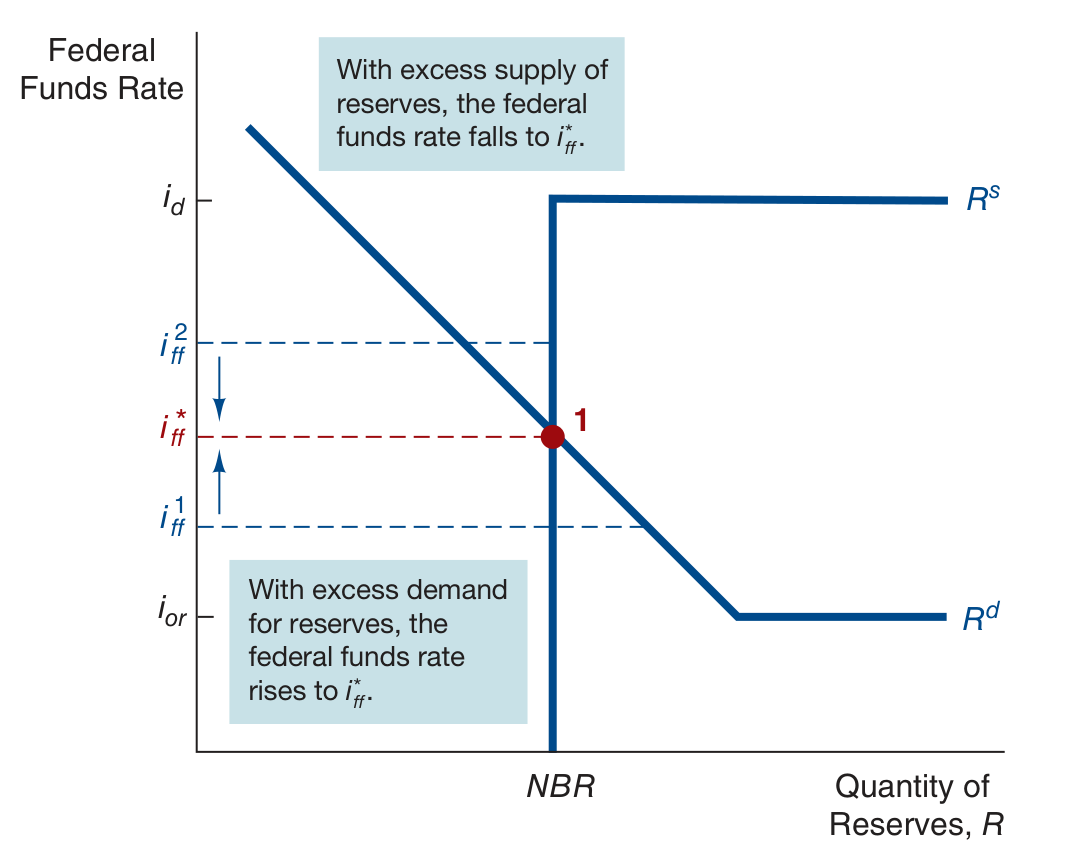
- \(R^d\): reserve demand, flat at \(i_{or}\), the interest rate paid on reserves
- \(R^s\): reserve supply, vertical at NBR (nonborrowed reserves), flat at the discount rate \(i_d\)
- Point 1: the equilibrium federal funds rate, \(i_{ff}^{*}\)
With scarce reserves, open market purchases shift supply right and lower the overnight rate.
Mishkin & Eakins, Financial Markets and Institutions, 9th Global ed. (2018), Figure 10.1, p. 248. Original figure.
How the Fed sets its rate today: a floor system
FOMC implementation note of 16 September 2026, effective 17 September. Reserve balances $2.930tn on 23 September 2026.
Four conventional monetary policy tools
| Tool | Mechanism in Mishkin Ch. 10 | Role in current frameworks |
|---|---|---|
| Open market operations | Purchases add reserves; sales remove them | Maintain reserve supply; with ample reserves, administered rates steer the overnight rate |
| Discount window | Collateralised central-bank loans add borrowed reserves | A liquidity backstop; the standing repo facility provides another secured funding channel |
| Reserve requirements | A higher ratio raises banks’ demand for reserves | US: zero since March 2020. China continues to use the ratio as a policy tool |
| Interest on reserves | The return on reserve balances creates the lower flat part of reserve demand | A main rate-setting instrument in the Fed’s ample-reserves system |
Reserve requirements affect liquidity needs and funding costs; they do not mechanically determine bank lending.
Session 2 · 45 minutes
Unconventional tools and the PBoC
When further rate cuts offer limited room, or funding markets break down, central banks can broaden their operations.
The tools can be combined. Liquidity lending creates a loan; an asset purchase transfers a security.
QE: asset purchases to lower long-term rates
| QE1 · 2008–10 | Agency MBS purchases expanded to $1.25tn in March 2009 |
| QE2 · 2010 | $600bn of longer-term Treasuries |
| QE3 · 2012 | Initially $40bn of mortgage securities per month |
| 2020–22 | Pandemic purchases; total Fed assets peaked near $9tn |
QE: the central bank buys securities outright.
Liquidity lending: it makes a repayable loan, normally against collateral.
Both can create reserve balances. Their assets, terms and policy purposes differ.
Lower long-term rates can reduce mortgage and business financing costs, and raise present values.
Federal Reserve purchase announcements, November 2008 and March 2009; Bernanke, 13 January 2009.
The Fed’s balance sheet, out and back
Since December 2025 the Fed has bought Treasury bills to keep bank reserves ample while cash in circulation grows. It raised its policy rate in September 2026 while still buying bills.
Federal Reserve H.4.1. Peak about $8.9–9.0tn in 2022; the reduction (quantitative tightening, QT) ended on 1 December 2025 after about $2.4tn; total assets $6.748tn on 23 September 2026.
Forward guidance and negative interest rates
Explain how future policy depends on economic conditions. Credible guidance can change expected short-term rates and borrowing costs today.
Rates below zero can ease financing. Limits include cash substitution and pressure on bank margins when deposit rates cannot fall equally far.
Inflation risks increased: the deposit rate rose to zero as policy tightening began.
Stronger wage and price developments supported a move towards sustainable 2% inflation.
The exits reflected changed economic conditions. Negative rates remain a policy option with benefits and limits.
ECB monetary policy decision, 21 July 2022; Bank of Japan framework decision, 19 March 2024.
The People’s Bank of China
- Founded 1948; commercial banking split off in 1983–84
- A ministry-level body under the State Council, China’s cabinet
- Governor nominated by the Premier, confirmed by the National People’s Congress
- Its Monetary Policy Committee is advisory and meets quarterly
Growth · employment · price stability · balance of payments · financial stability · structural adjustment.
One interest rate cannot reach six goals at once. The useful question is what the PBoC does about that.
Its answer is two sets of tools: one moves the price of money for everyone, the other steers credit to particular borrowers.
The PBoC’s toolkit
| Instrument | What it is | What it steers |
|---|---|---|
| 7-day reverse repo | Daily open market operation | The policy rate — 1.40% since 8 May 2025 |
| Standing lending facility (SLF) | Short loans to banks, on demand | The ceiling of the rate corridor |
| Medium-term lending facility (MLF) | Loans to banks, 3–12 months | The quantity of funds; no rate announced since March 2025 |
| Pledged supplementary lending (PSL) | Loans to the three state policy banks | Credit to named sectors |
| Relending | Cheap loans to banks, for lending to set borrowers | The allocation of credit |
| Required reserve ratio (RRR) | Share of deposits held as reserves | Liquidity needs and funding costs; average about 6.2% |
| Government bond trading | Outright, from August 2024 | Base money; ¥300bn net in H1 2026 |
Rate and liquidity tools affect financing conditions; PSL and relending also target the allocation of credit.
PBoC interest-rate reforms, 2024–26
Policy rate → interbank funding costs → bank lending rates. Transmission depends on liquidity, competition and credit risk; the loan prime rate (LPR) is a quoted lending benchmark.
Pan Gongsheng, Lujiazui Forum, 17 June 2026 (BIS Review). Administered benchmark deposit and lending rates were replaced earlier; the numerical money-supply (M2) target was dropped after 2018.
Targeted lending: benefits and risks
Cheap central-bank funding is conditional on eligible lending. Lower bank funding costs can create new loans, subsidise existing ones, or increase bank margins.
Pairs, then discussion · 4 min
Should the PBoC offer cheap funding for small-firm loans? Give one potential gain, one allocation risk, and a test of whether it creates additional lending.January 2026 programme terms: gov.cn and chinanews.com. Evaluation framework: BIS, Funding for lending programmes (2023).
Meeting 2
Session 3 · Payment systems and settlement
Session 4 · CBDC and stablecoins
90 minutes · central-bank settlement, payment infrastructure and digital money
Why payment infrastructure matters
Session 3 · payment systems
- Provide the settlement asset and accounts
- Operate core systems and oversee payment arrangements
- Support the liquidity needed to complete payments
- Wages, invoices and asset purchases need usable funds
- One institution’s outgoing payment is another’s incoming liquidity
- Common rules and reliable access support trust and competition
A failure to complete payments can interrupt real transactions and transmit stress between institutions.
CPMI–IOSCO, Principles for Financial Market Infrastructures; BIS, Central banks and payments in the digital era (2020).
Payment instruction, clearing and settlement
An irrevocable and unconditional transfer under the applicable legal framework.
A customer notification and final interbank settlement can occur at different times.
CPSS, Glossary of Terms Used in Payment and Settlement Systems (2003); CPMI–IOSCO, Principle 8.
One interbank payment on three ledgers
A customer at Bank A pays 100 to a customer at Bank B.
Bank A’s reserve asset −100
Reserve balance of B +100
Payee’s deposit +100
The customers hold claims on their banks. The banks settle their mutual obligation using balances at the central bank.
The customer deposit is a bank liability; the reserve balance is a central-bank liability.
Illustrative bank balance sheets; CPMI–IOSCO, Principle 9.
RTGS and net settlement: liquidity and risk
Bank A pays Bank B 100; Bank B pays Bank A 90.
- Settle the two transfers individually
- Gross payment value: 190
- Funding is needed when each payment is due
- Calculate offsetting obligations
- Net amount: 10 from A to B
- Manage exposures before final net settlement
If A starts with 100 and B with zero, A can pay 100; B can then reuse 90 of that receipt.
Liquidity needs depend on timing, incoming payments, intraday credit and the system’s rules.
Illustrative calculation; ECB, Economic Bulletin 3/2021, analysis of settlement balances and liquidity recycling.
The app and the payment infrastructure
| Layer | What it does | Questions to ask |
|---|---|---|
| Customer interface | Wallet, QR code, card or banking app | Can users and merchants access it? |
| Scheme and clearing | Messaging, common rules, routing and reconciliation | Which providers can connect, and on what terms? |
| Settlement | Transfer the settlement asset to discharge obligations | Which money is used, and when is it final? |
A service becomes more useful when more people and merchants can reach one another. Common standards can widen access; closed networks can limit competition.
A convenient interface depends on the institutions, rules and connections underneath it.
BIS, Central banks and payments in the digital era (2020).
China: private payment services and shared infrastructure
PBoC reforms centralised payment institutions’ covered customer reserve funds at the central bank, reaching 100% centralised custody in January 2019.
Customer-fund safeguarding supports trust without making every wallet balance a direct central-bank claim.
PBoC, customer-funds and payment-clearing reforms, 2018–19.
Instant payments can transfer existing bank money
- Accounts at participating banks or credit unions
- Payments and usable receipts around the clock
- The customer continues to hold bank money
- Launched 20 July 2023
- Participating institutions settle through Federal Reserve accounts
- Access, liquidity and operating arrangements support the service
An instant payment service can improve transfers without issuing a new currency to the public.
Federal Reserve, FedNow launch and service FAQ (2023).
Why do technology companies want payments?
Alipay: commerce and wallets · WeChat Pay: social messaging and merchants
Douyin Pay: payments within a short-video and commerce platform
| Commercial value | How payments can help |
|---|---|
| Complete the sale | Connect discovery, checkout, refunds and repeat purchases |
| Data and merchant relationships | Observe completed payments; offer analysis, coupons and merchant services |
| Fees and customer retention | Earn payment/service fees and keep transactions within the ecosystem |
| Customer funds held temporarily | Historically attractive for interest and bargaining power; use now constrained by safeguarding rules |
Customer funds are obligations to users; they are not freely available operating cash.
Alipay, WeChat Pay and Douyin merchant documentation; PBoC (2019); State Council payment regulation (2024).
Case — build a payment service or partner?
SituationA Chinese commerce platform already accepts Alipay and WeChat Pay. It is considering a licensed payment business of its own.
Business caseCloser control of checkout, transaction data and merchant services could strengthen its core business.
CostsLicensing, fraud losses, compliance, reliable operations and customer-fund protection require resources.
Pairs, then discussion · 3 min
Would you build or partner? Give one commercial reason and one cost. As a central banker, which safeguard would you require?The firm values revenue and customer retention; public authorities also value safety, access, competition and privacy.
Hypothetical decision informed by Alipay, WeChat Pay and Douyin services and China’s payment regulation.
Ledgers: who can update the record?
Session 4 · digital currency
A ledger records balances or ownership and the transfers that change them.
- An authorised operator maintains the accepted record
- Users rely on its rules, controls and accountability
- Copies across servers can improve resilience
- Participants check updates under shared rules
- A consensus mechanism resolves competing histories
- Security depends on that mechanism and its assumptions
Ask separately who validates transfers, who issues the money and who can change the rules.
Bitcoin white paper (2008); BIS, The technology of retail CBDC (2020); Federal Reserve, CBDC security (2022).
Why Bitcoin uses a blockchain
Alice sends the same coin to Bob and to Carol. Valid signatures show authorisation; the system still needs one accepted spending history.
Confirmation becomes harder to reverse as work accumulates; security still depends on network, computing-power and key-management assumptions.
Nakamoto (2008), sections 2–4 and 11; Bitcoin developer guide; Federal Reserve (2022).
Who controls the ledger and the money?
| Balance or token | Who validates the record? | Issuance and holder’s claim |
|---|---|---|
| Bank deposit | The bank and its authorised systems | Bank liability; the bank credits and debits accounts |
| Bitcoin | Open network under proof-of-work rules | Protocol issuance; no issuer promises fiat redemption |
| USDC · fiat-backed stablecoin | Can use public-chain validators | Circle issues/redeems; token controls include address blocking |
| CBDC · standard definition | Central operator or approved validators, depending on design | Central-bank liability and issuance authority |
A public blockchain can carry a centrally issued token. Distributed recordkeeping does not remove issuer authority.
BIS (2021); Bitcoin protocol documentation; Circle, USDC terms and token-contract design.
What a CBDC adds to a payment system
- Public access to a digital central-bank liability
- Possible roles in cash choice, inclusion and payment competition
- Wallets and services can be supplied by intermediaries
- Use by eligible financial institutions
- Potential changes to settlement access or functionality
- Can support new links between money and asset transfers
Existing reserves are already digital. Assess what changes in access, functionality and interoperability.
BIS, CBDC chapter (2021); ECB, proposed digital-euro design.
CBDC design: access, privacy and bank funding
| Choice | Potential gain | Trade-off |
|---|---|---|
| Distribution through banks and payment providers | Existing customer services and compliance capacity | Define responsibilities and fair access |
| Holding limits or no interest | Reduce incentives to move deposits out of banks | Limit convenience as a store of value |
| Offline functionality and privacy safeguards | Contingency use and transaction privacy | Security, loss controls and reconciliation |
| Interoperability standards | Broader merchant and provider reach | Governance and implementation costs |
The proposed digital euro illustrates these choices; privacy and resilience depend on the design.
ECB, FAQs on the digital euro, proposed design; checked 21 October 2026.
e-CNY bank wallets under the 2026 framework
e-CNY is China’s digital renminbi system.
- Account-based liabilities of the operating bank
- Registered balances earn demand-deposit interest from 1 January 2026
- Deposit-insurance treatment and reserve requirements
Governor Pan confirmed in October 2026 that e-CNY’s positioning had shifted from cash to deposit money.
These bank-wallet balances are claims on commercial banks. The standard CBDC definition instead refers to a direct central-bank claim.
Keeping a balance as a bank liability does not eliminate bank liquidity or insolvency risk.
Bank of China, 31 December 2025; government framework explanation, January 2026; Pan Gongsheng, 19 October 2026.
Stablecoins: backing, redemption and usable payments
Assets worth $100
Cash and short-term government assets
Quality and access matter during redemption.
100 tokens targeting $1 each
Issuance and redemption connect tokens to dollars.
Rights and eligible channels depend on the issuer.
Obtain tokens → transfer → convert if needed → redeem or sell for usable funds.
Continuous token transfers can coexist with fees, FX exposure and delays entering or leaving the network.
The redemption promise and the market price can diverge when access, liquidity or confidence is impaired.
Illustrative pool; FSB (2023), Recommendation 9; Circle, USDC terms and reserve disclosures.
Case — USDC and SVB, March 2023
USDC is a dollar-referenced stablecoin issued by Circle.
SituationSVB failed on 10 March. Reserve access was disrupted; primary-market redemptions were constrained over the weekend.
FrictionToken transfers continued while access to bank dollars and redemption was impaired.
RecoveryAuthorities protected SVB depositors on 12 March; redemptions resumed on 13 March.
Pairs, then discussion · 4 min
On that Saturday, would your merchant app accept USDC at $1, or temporarily accept bank dollars only? Explain the risk and the cost of your choice.Circle, March 2023 reserve updates; Federal Reserve FEDS Notes, 17 December 2025.
Main takeaways
- Central banks, independence and the market for reserves
- Unconventional tools and the PBoC
- Payment systems, shared infrastructure and platform incentives
- Ledgers, CBDC, stablecoins and the rights behind balances
- Policy implementation uses reserves and administered interest rates
- Targeted funding needs evidence of additional useful lending
- Transfers of 100 and 90 have gross value 190 and a net amount of 10
- Payment firms value data and merchant relationships; customer funds need safeguarding
- Separate ledger validation from issuance and redemption authority
- At-par redemption depends on legal rights and usable access to funds
Questions to Think About
- How can a delayed incoming payment create a liquidity problem for another bank?
- How would you test whether targeted central-bank funding creates additional useful lending?
- Why might a commerce platform want its own payment service? Where could its incentives conflict with public objectives?
- Can a stablecoin run on a public blockchain and still have a central issuer? Does full reserve backing ensure it always trades at par?
Use the ledger example and the two cases to support your reasoning.
Before Next Class
- Mishkin & Eakins — Chapters 9 and 10 for central banking
- Mishkin & Eakins — Chapters 11 and 12 for the money and bond markets, 26 and 29 October
- CPMI–IOSCO — Principles 8, 9 and 17: finality, settlement money and operational risk
- FSB (2023) — Recommendation 9 on stablecoin redemption
- Nakamoto (2008) — Bitcoin, sections 2–4; Circle — USDC terms
Monday 26 October: money markets. Thursday 29 October: bond markets.
References
- Mishkin & Eakins (2018). Financial Markets and Institutions, Chapters 9–10.
- CPSS (2003), Glossary; CPMI–IOSCO (2012), Principles for Financial Market Infrastructures, especially 8, 9 and 17.
- Alipay, WeChat Pay and Douyin, merchant documentation; State Council, payment regulation (2024).
- Nakamoto (2008), Bitcoin; Circle, USDC token-contract design; Fed, CBDC security (2022).
- Federal Reserve (2023). FedNow launch and FAQ; FEDS Notes (17 December 2025), USDC and SVB.
- PBoC (2019). Customer-fund and clearing reforms; Pan Gongsheng (2026), speeches of 17 June and 19 October.
- Bank of China (31 December 2025), e-CNY interest notice; government-hosted framework explanation (January 2026).
- BIS (2021). CBDCs: an opportunity for the monetary system; ECB, proposed digital-euro FAQ.
- FSB (2023). Global Stablecoin Recommendations; Circle, reserve updates of 13 and 15 March 2023 and USDC terms.
Appendix
Optional depth
Overnight-rate bounds, operating frameworks and dated source snapshots.
Appendix — where an overnight secured rate should trade
A bank with reserves can earn \(i_{\text{IORB}}\) risk-free, so it lends in the repo market only at \(r \ge i_{\text{IORB}}\). A money fund cannot hold reserves but can use the overnight reverse repo facility, so it lends only at \(r \ge i_{\text{ONRRP}}\). Anyone short of cash who can use the standing repo facility borrows there at \(i_{\text{SRF}}\), so never pays more. Together:
Repo traded as high as 4.27% during the day against a facility rate of 4.00%, and banks borrowed $50.35bn at the facility, the most up to that date. The bound holds only if using the facility costs nothing extra. In practice it uses balance-sheet space at month-end and carries a reputational cost, so the true condition is \(r_{\text{repo}} \le i_{\text{SRF}} + c\), and \(c\) cannot be seen until the bound is tested.
Appendix — three operating frameworks
| Federal Reserve | ECB | PBoC | |
|---|---|---|---|
| Stance rate | Target range 3.75–4.00% | Deposit facility 2.50% | 7-day reverse repo 1.40% |
| Operating target | Effective fed funds rate | €STR (overnight) | DR001 |
| Regime | Floor, ample reserves | Narrow corridor (15bp) | Corridor 50bp since June 2026 |
| Ceiling | SRF and discount window, both 4.00% | Marginal lending facility | SLF |
| Reserve requirement | 0% since 26 March 2020 | 1% of eligible liabilities | Weighted average ~6.2%; floor 5% |
| Balance sheet | QT ended Dec 2025; buys bills | Running off | Bond trading; ¥300bn net, H1 2026 |
| Conditional funding | Emergency programmes have included PPPLF | Targeted longer-term funding has been used | Relending, PSL; −25bp Jan 2026 |
Fed figures effective 17 September 2026; ECB 16 September 2026; PBoC as at September 2026.
Appendix — examples and dated snapshots
| Item | Value or scope | Reference date |
|---|---|---|
| Interbank example | A pays 100; B pays 90; bilateral net amount 10 | Illustration |
| Payment customer funds | Prescribed custody; appropriation, borrowing and pledging prohibited | Regulation effective 1 May 2024 |
| USDC at SVB | $3.3bn, about 8% of reserves; access disrupted, not an eventual $3.3bn loss | Mar 2023 |
| FedNow | Instant payment service; customer bank-money claims retained | Launched 20 Jul 2023 |
| Bank e-CNY wallets | Registered balances earn interest; bank-liability implementation | 2026 framework |
| First-meeting Fed snapshot | 3.75–4.00% target; IORB 3.90%; reserves $2.930tn | 17–23 Sep 2026 |
| First-meeting PBoC snapshot | 7-day reverse repo 1.40%; relending 1.25% | Jan–Sep 2026 |
Historical events and snapshots retain their stated dates; primary sources are identified on the relevant slides.